
Life is Complex – It’s in Our System!

Life is Complex – It’s in Our System!
ABSTRACT
Living systems at all levels of life - from the simplest organisms to human institutions and endeavours, can be usefully visualised through a lens of “Complex Adaptive System” (CAS) models. To survive and flourish (over and above satisfying its essential resource needs) the CAS, as a network of partially interacting agents, depends on a propitious mix of cohesion and innovation throughout.
At the human level, for a manager or leader facing difficult circumstances, thinking in terms of “complexity” (where people and reality collide) in order to achieve this mix can be key to guiding their endeavours to prosper.
This essay offers a foundation for viewing “complexity” in “living systems” at any level from “Cells to Civilisations”. It is based on the author’s experiences and learnings across a range of disciplines (social, information and physical sciences) and their applications in business government and technology. While essentially conceptual, it is expressed in everyday language as far as practicable.
The foundation sets the scene for how complex systems - societies and endeavours - can form, grow and decline, and cites the place of resources, relationships, leadership and organisation, through to institutions and culture at the human level. With this perspective insights emerge for understanding and managing complexity where it is encountered - whether in our world and communities generally, in our business, government or other endeavours, and even in our close relationships.
It is the author’s intention for further essays and forum activity in this substack to illustrate complexity in practice - how it is encountered and managed and useful insights to be gleaned.
1. Introduction
Life is complex; often heard from leaders and analysts in difficult situations, “there is too much information” or “I can’t process the information I have”, “it is too risky, with too many unknowns”. Equally from ordinary people having to make increasingly difficult everyday decisions about their lives and families.
Everywhere, people wonder:
How can my group (society, work or business) operate effectively in erratic circumstances to succeed in its objectives? Are my objectives sound?
How can I best deal with competition to my endeavours, internal disrupters, threats or hidden risks?
How can I, as an ordinary person take in a world-view and make better sense of the apparent chaos that is happening around me?
In learning to deal with such situations in different spheres and endeavours, the author has had the benefit of a most fortunate upbringing and an adult life with experience in government, academia, business and non-profit sectors, also studying and working across many disciplines and in different cultures 1. Over the years, while clients may show little interest in the theory, they are keen to see it applied to the particular complex endeavours they need to manage. The principles that apply to management under complexity are often “hiding in plain sight” and easily overlooked just when needed in stressful situations.
Observing and understanding complexity (wherever it crops up) is most helpful for dealing with it effectively in one’s particular circumstances and for judiciously considering questions about what is happening in our world or even down to our local communities and families.
This essay, the first in a series, introduces a model for “complexity” (where life and reality collide2 ) in a “society” (populations of partially autonomous interacting agents 3 - e.g. people but equally animals etc), its ubiquity in all endeavours, organisations and institutions, its appearance across social groups at all levels - from “Cells to Civilisations” - and how complexity can create opportunity or cause critical disruption.
Future essays – as forum readers demand – will address, indicatively complex phenomena across a range of topics, from human history, behaviour and institutions (in politics, economics, business, communities, beliefs and ideologies), to collective behaviours of other animal and life forms. The essays will be intended to illustrate (or hypothesise) the connections between the individuals and their social setting, how the society or group level behaviour reflects the interests, incentives, capacities and resources of the individuals.
At the human level topics may cover the range of personalities, endeavours and behaviours, both constructive and destructive, power, business and government .
Rather than asserting doctrinaire solutions, this work begins with inquiry:
What allows systems—biological, social, institutional—to survive, grow and prosper?
What patterns precede breakdown and failure?
How to manage within complexity?
What principles can be derived that are robust across cultures and contexts?
The aim is not to seek uniformity, but to identify essential commonalities and conditions under which systems of life will flourish.
Human life does not stand apart from nature; it is an extension of it. Each individual agent is itself a system of systems—cells, organs, cognition, emotion— and is embedded within larger systems: families, institutions, economies, cultures, and civilisations. These are not static structures but complex living systems: dynamic, evolving, and often unpredictable.
Across these layers, certain recurring and potentially conflicting features emerge:
Interdependence or Isolation
Equilibrium or Disruption
Emergence or Design
Fragility or Resilience
These are persistent tensions that shape how living systems flourish or fail. They are not incidental, they are conditions under which life continues.
Yet modern human societies often behave as though they are exempt from these realities — as though intention alone can override complexity. The consequences are visible: institutional brittleness, social fragmentation, policy failure, economic collapse, ecological strain, and the persistent reappearance of crises thought to have been solved.
While the ideas are the author’s own, they have been expressed here with some assistance from and argument with ChatGPT.
READER WARNING - TERMINOLOGY
In this essay, as in novel exploration of concepts generally, terms may be stretched (perhaps clumsily) beyond their familiar or conventional meanings. While new terms are frequently used as concepts are being developed and broadened, this can jar the reader initially 4 . Two key examples occur here:
“Society” is used here in a deliberately broad sense to describe a population of interacting partially autonomous agents. Conceptually this may cover a bacterium colony, that is not ordinarily called a society.
“Life” and “living system” are used here functionally rather than biologically; they do not mean that the system or agents are alive in its usual sense. An observer may attribute characteristics to an ant swarm, or human endeavours or institutions, that suggest they exist as independent life forms when they don’t.
2. Overall Theme
Living systems (i.e. “Societies”) are in essence “networks of partially autonomous interacting agents” that may be described in terms of a “Complex Adaptive System” (CAS) “thinking model”. From this perspective, a keen observer will see in the network – its agents and their interactions - structures, norms, and patterns of behaviour emerging; astute managers can then use that understanding to advantage in their endeavours.
This essay describes in general terms a framework for how a society – including any “sub-societies” - forms and sustains itself, and how it promotes, coordinates and moderates its agents’ behaviours, thereby maintaining the distinctive identities, alignment, responsiveness and resilience it needs to survive and thrive within its environment.
At the core of this framework lies the concept of the “intentionally sustainable society”; a “society” - at any level, from “Cells to Civilisations” - whose population (of agents) is broadly intent - individually, and in groups, although not uniformly aligned (and some even perversely behaving) - on its sustainability and development.
For this purpose, the healthiest societies will be optimally “complex”, exhibiting both collective action (alignment to efficiently use its resources and improve performance) and innovation (for maintaining resilience and capacity to adapt to challenges). (In practice a society will always, be harbouring some perverse actions that can detract from the society’s health also.)
Such complexity (exhibited in a mix of innovative adaptation and collective alignment) is readily observed across the range of living systems from the simplest organisms through plants and animals to the most advanced forms of life (Figure 1). This model offers a basis for exploring how complexity operates from the uni-cell through to human structures and cultures, and to endeavours where the complexity can be managed and used to advantage.
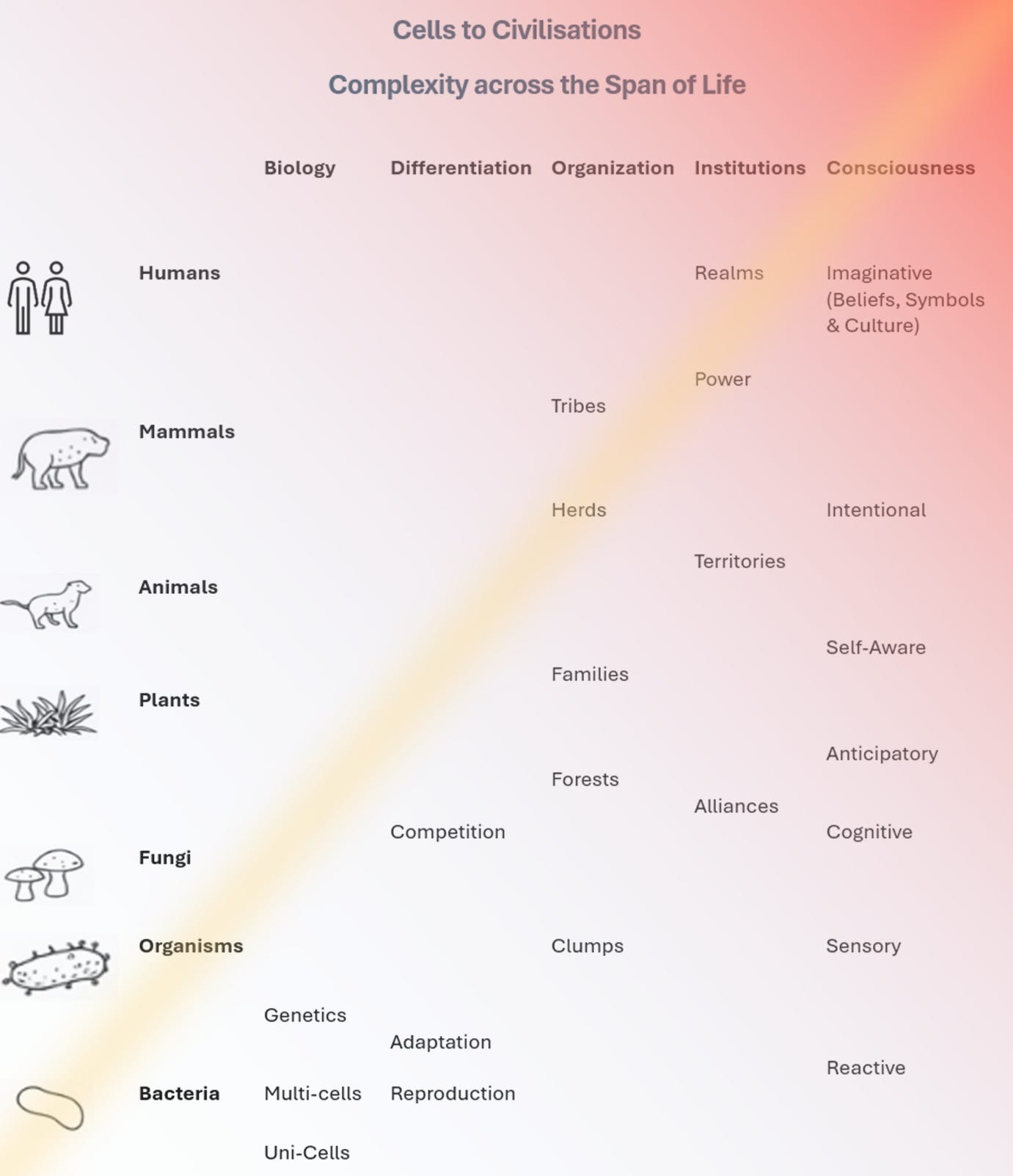
Every complex life system, from cells to civilisations, faces four enduring needs to:
secure and allocate resources,
maintain sufficient cohesion,
innovate and adapt in changing circumstances, and
develop and subscribe to shared meaning.
In the case of human societies and endeavours, leaders and institutions emerge, which coordinate behaviour, also promoting knowledge, rules, meaning and beliefs in the population. These aspects are crucial for pursuing prosperity for their endeavours; but they also create opportunities for leaders using their influence over compliant members to pursue private agendas that are perverse to the interests of the society as a whole.
The model suggests, and further essays will address, how societies (generically) can flourish and fail and the essentials for intentionally sustainable endeavours.
3. Dual Requirement: Cohesion and Freedom
For a society (or group) to endure, it must exhibit two essential and tension-filled features:
Collective cohesion — the population, especially when under stress, broadly aligned and acting in concert.
Individual freedom — the capacity to adapt, innovate, and deviate constructively from accepted norms of behaviour.
These are not opposites to be weighted and balanced linearly, but forces governed by threshold dynamics in the particular context (in changing circumstances and time) of the society. Neither should dominate to the extent of that it jeopardises the other. Too much cohesion leads to rigidity, restricting capacity to innovate; too much freedom permits inefficient fragmentation and decline. 5
One can readily observe examples of these features in nature at many levels 6.
Importantly, both features operate not only at the level of the whole society, but recursively within constituent groups down to individual agents. In any society individual personalities and groups are distributed unevenly across this cohesion-freedom space: some personalities gravitate toward conformity (and extreme rigidity or intolerance, which may need to be checked for the society’s health), while others stray toward personal autonomy, curiosity or extreme anarchy and crime (which needs to be reined in for the society’s health).

4. Primary Drives: Survival, Belonging, and Enjoyment
Underlying the cohesion-freedom spectrum, at the level of the individual, behaviour is shaped by a mix of fundamental drivers: to survive, enhance well-being (enjoyment), and to belong in a group or tribe.
Progressively:
cells need nutrients,
plants also crave light,
animals hunt for food,
businesses require capital,
states pursue territory,
ideologies seek followers.
Access to survival essentials — food, water, shelter, energy — is best mediated not in isolation but through group membership. Groups enable efficiency through coordination of labour, exchange, protection, learning, comfort and identity. Belonging to a group carries benefits and costs, involving coordination through exercise of power (both leading and following) relationships.
Beyond subsistence therefore, individuals gain satisfaction through consumption, ritual and group participation, social recognition, and trust. These can carry, in addition to the sense of immediate fulfilment, risk consequences; misjudged trade-offs between present and deferred costs and well-being (including costs for future generations), causing weakening (flowing also to the group) through excess and dependency 7 .
5. The Cognition Bridge: Sensing to Belief and Culture
Any life form—indeed any agent at any level—necessarily interacts with its environment and with other neighbouring agents. This entails some form of awareness or information processing within the individual, however minimal. At its most basic, an organism exhibits sufficient responsiveness to detect, acquire, and utilise the resources (or host tissue) required for survival, growth, and reproduction.
Across the range of life forms this capacity develops into increasingly sophisticated cognition: the ability to interpret situations (e.g. as threats or opportunities), remember, anticipate changing conditions, and learn from experience. With this development comes a growing awareness of other agents and of the broader environment, and, in more advanced forms, consciousness and self-awareness, together with the capacity to imagine and act with intention.
Memory, awareness, imagination and intention enable reflection, and even dreaming— the capacity to represent alternative realities and possible futures—which in turn permit planning. With these capacities concepts and beliefs are formed and representations of possible futures framed. When exercised collectively, the capacities give rise to language, shared communication, and ultimately beliefs and culture.
These progressively developed cognitive capacities constitute an essential “bridge” from an agent's biological nature to the emergent organisational and institutional character of its society. 8
6. Coordination: Leadership, Rules, and Enforcement
Power emerges naturally within these structures, imposing order through exercise of force and influence through processes of ritual and control of wealth:
force - coercion with hope of relief,
influence - persuasion and trust
ritual – obeisance, ceremony and art, and
wealth -control (withholding and distributing) of valued resources.
Accompanying the exercise of power, coordination mechanisms also emerge.
Leaders 9 play coordinative roles in:
reinforcing cohesion,
deterring destructive behaviour, and
enabling innovation (within limits).
Through the exercise of power, leaders attempt to regulate departures (from accepted or imposed norms), and extremes of behaviour especially, if they threaten systemic stability (order). Yet this introduces a persistent dilemma: overreach versus underreach.
Overreach suppresses innovation and breeds resentment (fuelling more widespread desire to deviate, or even revolution)
Underreach permits fragmentation and disorder.
No ready resolutions exist; societies are dynamic and continuously circulate around this problem, most often imperfectly 10. This dilemma persists equally if influencers act - perversely to the interests of their wider groups – to enhance the power of minor sub-groups; e.g. by fomenting disorder broadly through destructive or narrow activism.
7. Territoriality and External Competition
Societies do not exist in isolation. Their drive to survive and thrive extends outward, manifesting in diplomacy, competition, defence, and conflict, typically for gaining or preserving their dominance, e.g. wealth or growth.
The internal leadership overreach-underreach tensions also apply externally:
excessive aggression creates overextension,
excessive restraint signals vulnerability.
Thus, the dynamics of cohesion and freedom scale beyond the individual or groups and even the society itself to the broader landscape of aggression and restraint among competing societies in their environment 11.
Recursively, the society and its external relations (e,g, with competitors and allies) are themselves a larger complex system – sometimes but unnecessarily called systems of systems).
8. Leadership and Opportunity
Within the complex social system environment, there are inevitably opportunities for individuals or groups to exercise leadership and influence. This can variously:
strengthen collective capacity (cohesion) and resilience (innovation and adaptation), or
exploit asymmetries in resources and power for private gain.
This dual possibility is pivotal; the same mechanisms that enable societal flourishing can, in different situations (distributions of power and resources), levels of abundance, and incentives, accelerate decline. Understanding this duality is essential for analysing leadership, innovation, institutional emergence, and the exercise of power 12 .
9. Belief and the Construction of Meaning
A critical dimension of social coordination lies in the construction of shared meaning.
Leaders and influencers in a society shape behaviour not only through coercion and reward, but by framing narratives (including) of explanation, hope and dread, establishing norms, embedding them in ritual and symbols, and monitoring responses by their followers and by interested outside observers.
Three mechanisms are especially important:
Culture — inherited patterns of understanding and behaviour, followed with minimal questioning
Training — direct reinforcement of desired understanding and behaviours through authority
Belief — reliance on unseen forces with perceived agency over outcomes
Members of groups may readily accept (collectively or individually) concepts of an ideology or religion - or an idol (understood broadly as an unaccountable, intangible, personified, force with agency). They may find that the belief provides:
explanation for uncertainty and risk,
rules for compliance,
hope for or reward in the future,
legitimacy for otherwise uncivil actions,
justification for punishment or scapegoating for failures,
opportunities for redemption, and
emotional anchoring through ritual and symbols.
Crucially, it is leaders and influencers who define the terms of obedience, and what behaviours constitute compliance or transgression (or pleases or displeases the perceived force).
The propagation of such belief mechanisms can be highly efficient. Persuasion through shared meaning often proves less costly and less risky for leaders than reliance on material or physical incentives, or coercion alone 13 .
10. On Science, Philosophy, and the Status of the Framework
This framework is presented as a theoretical model grounded in a complex adaptive systems perspective, rather than as an established fact.
It distinguishes between:
observation, which underpins scientific inquiry, and
belief, providing interpretation, tradition, or explanation, and shaped through leadership, influence and response.
Scientific theories, properly understood, are not final truths but models that are accepted only insofar as they resist falsification.
Accordingly, this framework is open to:
empirical challenge (through observation - science), and
conceptual critique (through philosophical reasoning).
It is intended not as a conclusion, but as a scaffold, subject to inquiry through many disciplines 14, into how societies generate norms, exercise power, and construct systems of meaning.
It is, at the same time, intended to be quite powerful as a general model of how societies generate behaviour through layered emergence. For human societies, it is intended to provide a foundation for analysing culture, governance, ideologies, beliefs, endeavours and institutions.
Philosophically, it echoes and has much that aligns with other thinkers’ views on political and sociological frameworks 15.
11. Conclusion: A Stepping Stone Toward Effective Management, Policy Decision-making, and Human Understanding and Culture
This analysis does not attempt to resolve metaphysical, scientific or philosophical questions. Rather, it provides a lens through which they can be viewed, and how endeavours, organisations, and the institutions built around them, may be examined, understood and effectively managed.
Further essays may address a wide range of subjects with examples, covering such aspects as:
where these principles can be observed - in nature and human endeavours,
how they intertwine with views from philosophy and science,
mechanisms that have evolved in human discourse; language, education, politics, government the literature, arts, humour, and belief systems,
insights for more effective management of complex human endeavours, organisations and institutions.
the search for an intentionally sustainable society – the essential pillars, and
many other topics 16.
Understanding societies (at all levels “From Cells to Civilisations”) as complex systems - balancing cohesion and freedom, shaped by power, meaning, and adaptation - offers a foundation for exploring how real-world relationships and organisations work, how institutions, scientific knowledge and philosophical reasoning can flourish or decline, how religious and non-religious worldviews emerge, persist, and influence human flourishing.
Reader responses are welcome and invited through this forum, both in relation to the theories about complexity, and suggesting specific areas to be addressed in future essays.
Footnotes
The Author
For some information about me, see the following note. It’s a bit personal but you should know who’s thinking is behind this content
The content is based on the author’s most fortunate life, and his experiences and background across a range of disciplines (social and physical sciences and their applications in business, government, industry and technology).
My clients, even if the theoretical ideas about complexity were not immediately compelling, would eagerly draw on the results. While impatient particularly when under pressure, they see it is vital to understand complexity as it applies to the endeavours they are managing, and to see how the ideas can help them effect improved performance.
“Complexity”
The term “complexity” as used in this essay and throughout refers, not to large size (as in major infrastructure projects) or intricacy (as in design of large scale integrated circuitry), as complicated as they can be, but to a higher level, which is the behaviour among individuals or autonomous agents (interacting with each other) and the realities of their circumstances and environments – “where life meets reality”.
In a bird flock flying in formation theory suggests that each bird can sense the air flow and turbulence from its near neighbours and adjusts to both keep in line and avoid wasting effort. The peloton in a bicycle race is a well known example of biomimicry
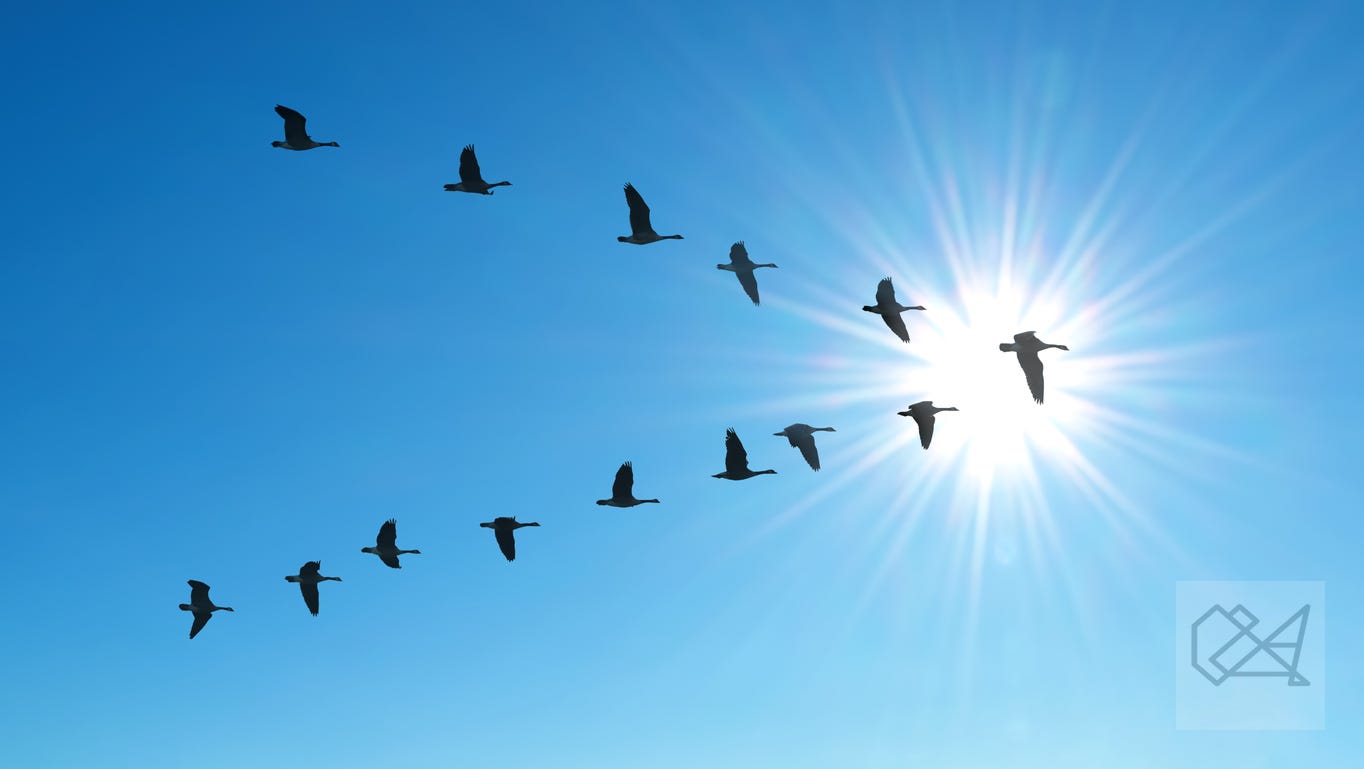
When either extreme (1) there is no shared information or (2) all agents in the system have complete of all the others’ situations (100% shared information), complexity is NULL. For present purposes, the forms of complexity of greatest interest lie between these extremes, At either extreme there is little scope for emergence of the adaptive behaviours that characterises complex life systems. Prudent leaders would rarely if ever never seek to eliminate complexity in their endeavours; too little information sharing ensures chaos, while too much is a recipe for inefficiency.
What is a Society?
A society in the sense of this essay is a complex system consisting of members in a network of interacting partially autonomous agents. The concept in its full generality includes for example:
organisms in clumps or colonies,
fauna groups in forests,
animals in herds,
humans in tribes, communities and nations.
A Society reflects in aggregate the diverse behaviours of its individual agents.
The prospects for a society’s success or decay is maximised by the manner in which its agents combine to pursue its objectives.
My Society
In one agents’ society (its family and community) are by extension others who interact, directly or indirectly, and helpfully or otherwise. At the human level, by understanding others’ behaviours in the society and its environment one agent can better gauge how to propel the success of the agent’s own endeavours.
Other life forms
Philosophers and scientists have long contemplated ideas of “distributed intelligence" in forests and among animals. Bees and ants swarm in ways that suggest to an observer that they are exhibiting a kind of collective intentionality in securing the resources they need or defending against threats.
The interacting agents model can be extended conceptually to the bare biological level. For example , the author has had occasion to consider the infection cycle that occurs in people with Cystic Fibrosis. The infective Pseudomonas Aeruginosa bacteria colonize the airways of people with cystic fibrosis where they can persist for decades. To escape the immune system and resist antibiotic treatment, they survive by modifying their traits, mutating and changing gene expression. They strengthen persistence in the host through metabolic specialisation, moderating growth rate and forming a protective biofilm.
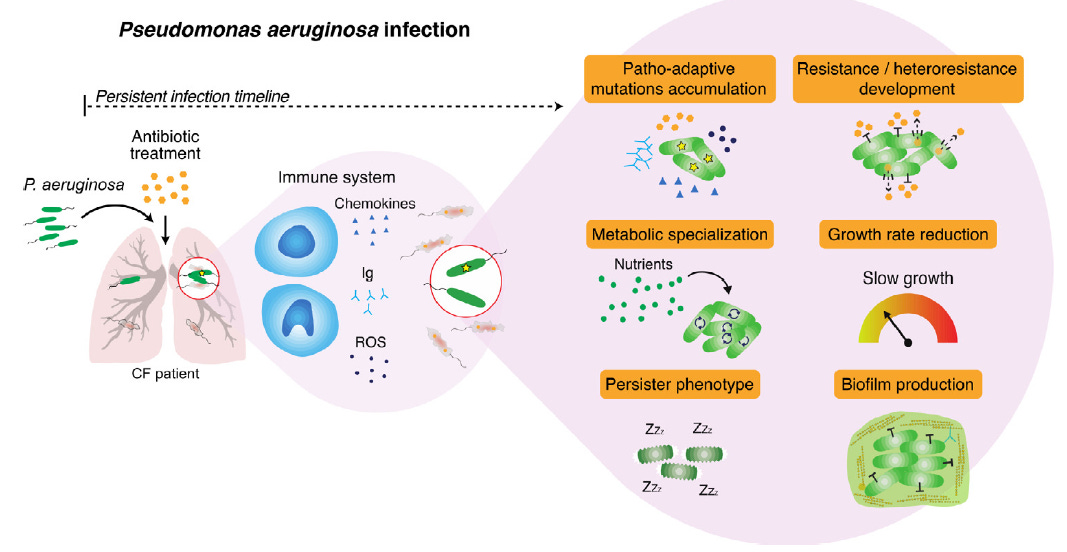
See https://www.cysticfibrosisjournal.com/action/showPdf?pii=S1569-1993%2822%2901387-X: “New Concepts in Antimicrobial Resistance in Cystic Fibrosis Respiratory Infections”, by Pavel Drevinek, Rafael Canton, HelleKrogh Johansen, Lucas Hoffman, Tom Coenye, Pierre-Regis Burgel, and Jane C Davies, published in Journal of Cystic Fibrosis.
Interacting agent models are also suggested in emerging researches on communication between plants. See “Volatile communication between barley plants affects biomass allocation”, by Velemir Ninkovic, published in the Journal of Experimental Botany (https://academic.oup.com/jxb/article/54/389/1931/534655). The article reported how plant–plant communication affects trade‐offs between root, stem and leaves, and relative growth rates.
Terminology
Arthur Koestler (The Ghost in the Machine, 1967) coined the terms “holon” and “holarchy” to describe behaviour in social hierarchies. The holon may be a cell in a body, or a word in a sentence and may refer to a part or the whole; holarchy is then a hierarchy of “holons”. The author has chosen to not adopt these terms here to avoid inconsistencies.
“Threshold dynamics” refers to systems in which outcomes change non-linearly once certain critical balances (thresholds or tipping points) are breached, rather than varying smoothly with incremental change. The concept is widely used in complex systems theory, including in studies of social coordination, network behaviour, and resilience.
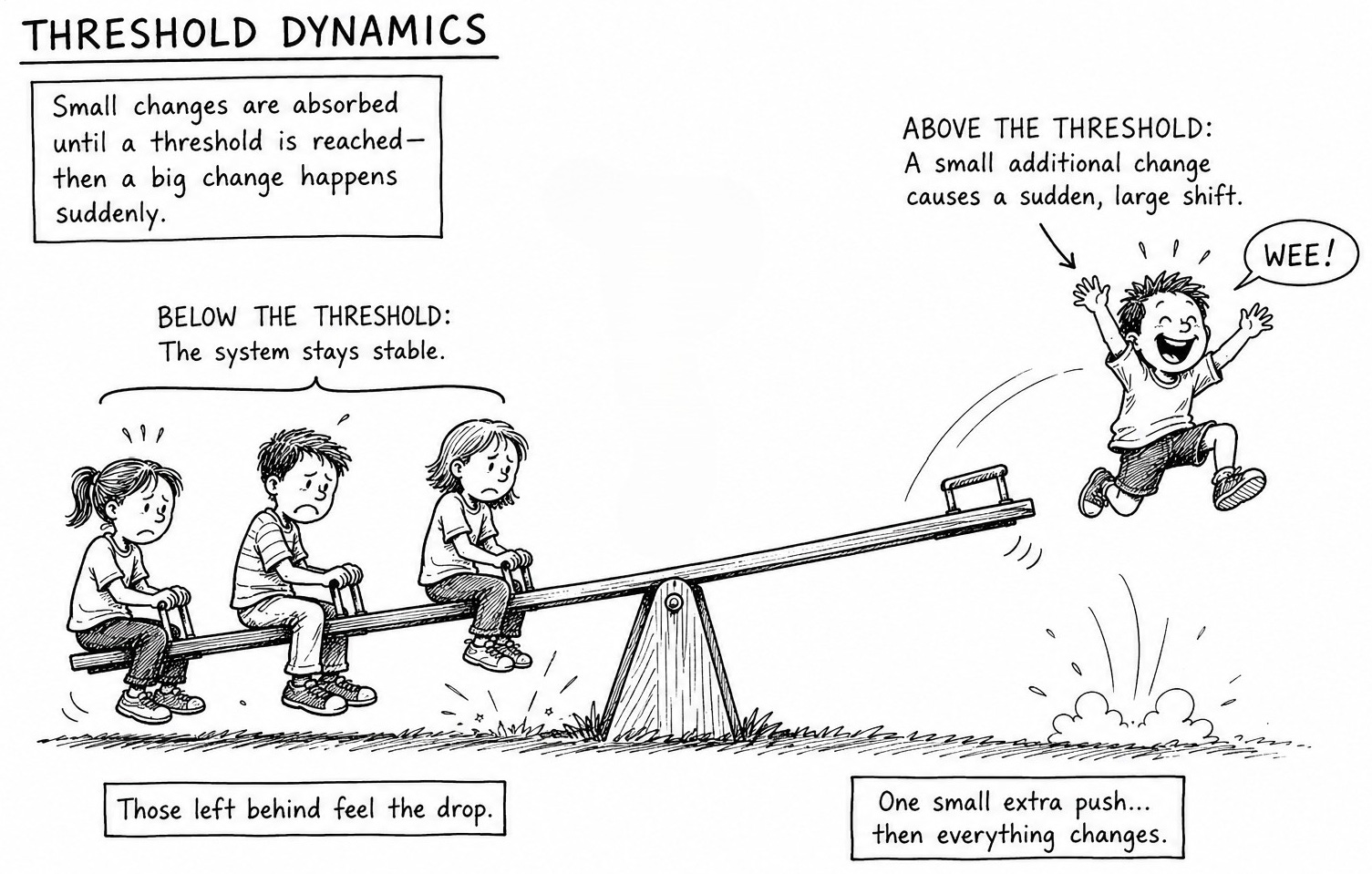
In this essay, the term “threshold dynamics” is used to characterise situations where competing features or ideologies (e.g. freedom v. conformance) need to coexist – a dynamic, uncomfortable harmony finding appeal by moving between boring unison and offensive cacophony.
[My reader commenting on this feature referred me to Wagner, in Tristan und Isolde - Prelude, keeping the music hovering near the “edge” — never collapsing into chaos, never settling into comfort]
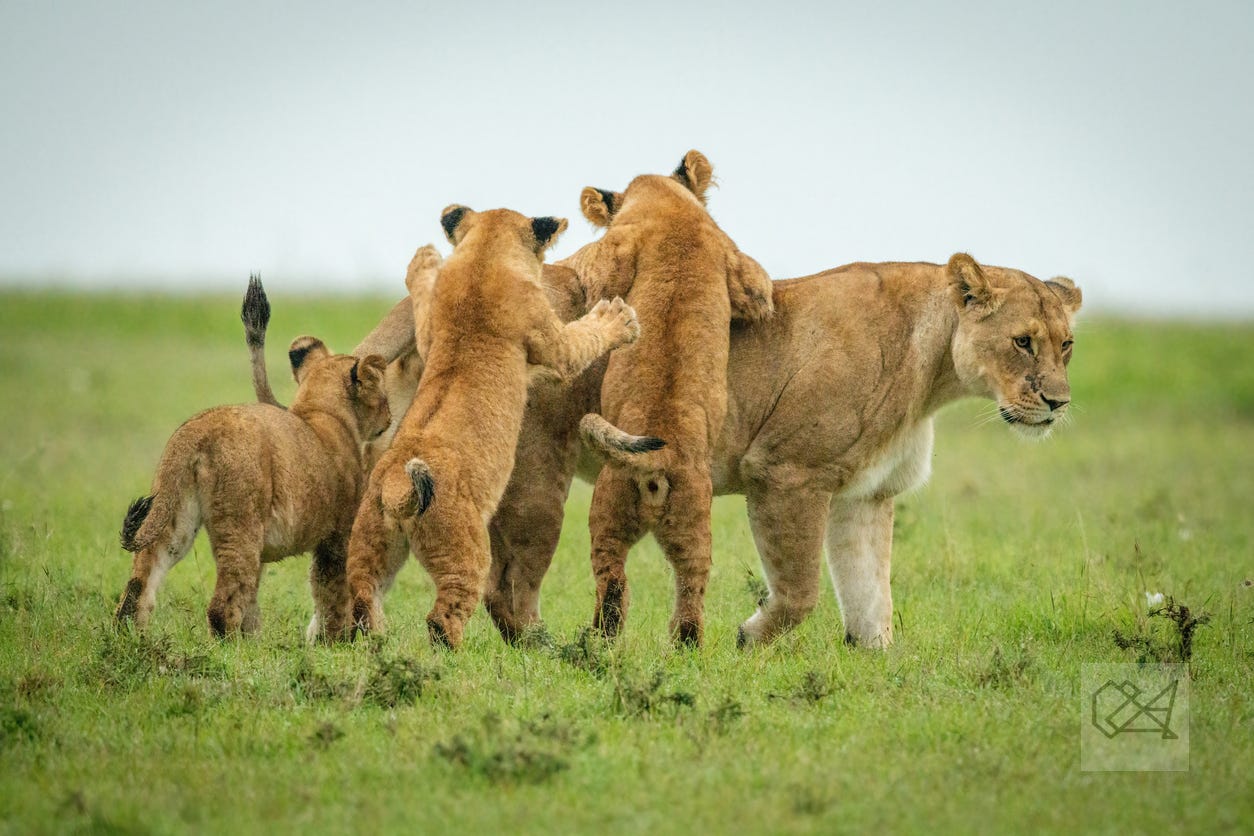
Pride of Lions - Cohesion and Freedom
In a pride of lions, the cubs will be playing, quarrelling, and annoying their mothers, until danger appears at a distance, when they are immediately pulled into line. One that strays from a threatened pride can be an easy pick for predators. \
Excess and Dependency
Common examples in human societies and groups basking in the “curse of abundance” are substance abuse (drugs and alcohol), gambling, and other co-dependencies. For many risky adventure activities (e.g. as in extreme sports) there can be a threshold between personal challenge and wilful recklessness, seeking immediate reward even knowing the long term costs and risks.
The Cognition “Bridge”
The conception of cognition as a bridge from biological existence to social institutions has affinities with John Searle's account in Making the Social World (2010), in which institutional facts such as money, government, and marriage arise through collective intentionality and shared recognition that certain persons, objects, and acts "count as" having particular status and functions within a community. The present essay places this account within a broader developmental sequence extending from biological responsiveness through cognition to imagination, beliefs, culture, ritual, and institutional formation. See also John Searle, The Construction of Social Reality (1995), Conclusion pp. 227ff, where he argues that biology and the social sciences are not in opposition, and that, if they were, "biology would win".
Leadership
The term “leaders” is used generally here in the sense that it describes those who other members in their groups follow or are influenced by; it is not limited to meaning those who are appointed as heads of an organisation or institution.
Power Overreach and Underreach
Systems fail not only when control is too weak to promote adaptation, but also when it is too strong to permit it. In practice, failure often arises from both at once — rigidity at the centre and fragmentation at the edges. A clear example (there are many) is the suppression by Kodak central management of its digital photography inventions, leaving opportunity for its exploitation by other firms in the industry.
Aggression and Restraint
While there is no shortage of polarised opinions about the current Middle East conflicts, history is yet to judge whether and to what extent the parties so deeply involved (and those on the sidelines) have been displaying excessive aggression or restraint and for what purposes.
Power asymmetry in Commerce
The commercial world is full of power asymmetries, with firms seeking market power over competitors and consumers and suppliers (including internal suppliers of labour and skills). In reaction Governments try to prevent unfair use of monopoly and exploitative power and to regulate the operation of natural monopolies. Monopoly positioning and over-regulation can both lead to reduced capacity and interest in innovation. In Australia the monopoly position of Telecom and its political regulation ensured the industry remained technologically “sclerotic” for years until finally it was privatised and exposed to global technological realities and competition.
Belief and Meaning
In the course of human history leaders and influencers have always developed and used (and mis-used) belief systems and religion (and also restricted and regulated religious practice and organisation) to cement their power positions and further their private agendas. The illogicality of mandating beliefs (and then criminalising “non-belief”) is easily overlooked when exercise of power is at stake. Of course, within religious institutions and narrow ideological movements constructed to further the common good or pursue some particular ideology, the exercise of power is often no better disguised. Historically in religious traditions, essentially promoting both “belief in the divine” and “care for others”, institutional power has at different times so greatly distorted the “pure” ideologies that “followers” are effectively coerced or enslaved. For the interested reader is a subject for future essays.
Multidisciplinary Foundations
This work draws on multiple domains from the author’s experience, study and ongoing learning, each offering partial but valuable perspectives:
Science - falsifiable, evidence-based understanding of the natural world
Mathematics – how concepts operate and connect, tools for modelling structure, uncertainty, and emergence
History - patterns of emergence, success and failure across contexts and time
Literature - human experience in its richest and most nuanced forms
Philosophy - meaning, ethics, and the nature of knowledge
Law and institutions - attempts to stabilise and coordinate behaviour
None of these domains alone is sufficient. Together, they form a mosaic through which deeper patterns may be discerned.
Indicative Range of topic areas
Complexity Theory – Principles Hiding in Plain Sight
Patterns in “Cells to Civilisations” – insights for managers
Human Systems – Families to Institutions
Power and Leadership – Use and Abuse
Geopolitics – Diplomacy, Competition, Aggression and Restraint
Environmentalism and other Ideologies
The Curse of Abundance
The Purpose of Education
Economics, Welfare, Investment, Growth and Resilience
Private property, taxing the rich
Military organisation, central command and guerrilla structures
Government, socialism, conservatism, democracy, autocracy
Knowledge and Meaning, Ideologies, Beliefs and Religion
Language devices - Expression, Freedom
Management and Design for Human Endeavours in Business, Government agencies and Institutions